Coastal Christmas: How to Decorate for the Holidays Without the Red and Green
Every December the same box comes out of the garage, and every December it fights the house. Red velvet, green tinsel, a wreath the color of a traffic light. It is not that any of it is ugly. It is that a coastal home spends eleven months pale, warm, and quiet, and then spends one month being someone else’s living room.
You do not have to choose between decorating for Christmas and keeping the house you actually like the rest of the year. Coastal Christmas decor is a restyle, not a takeover. The palette barely moves: add greenery, candlelight, and one metal, and take the red out entirely. What is left reads unmistakably like the holidays and still looks like the room you live in.
At our house, Christmas usually starts the weekend after Thanksgiving. I am happy to bring out the greenery and candles. The red tinsel can stay in the box.
The coastal Christmas palette
Start with what is already in the room: white, sand, pale wood, soft blue, or sea-glass green. Add evergreen, warm candlelight, and either brass or silver. You do not need to introduce Christmas red simply because it is December. The coastal Christmas decorating ideas below all work off it.
The mantel: five rules
The mantel is the room’s stage, and where a coastal Christmas is won or lost.
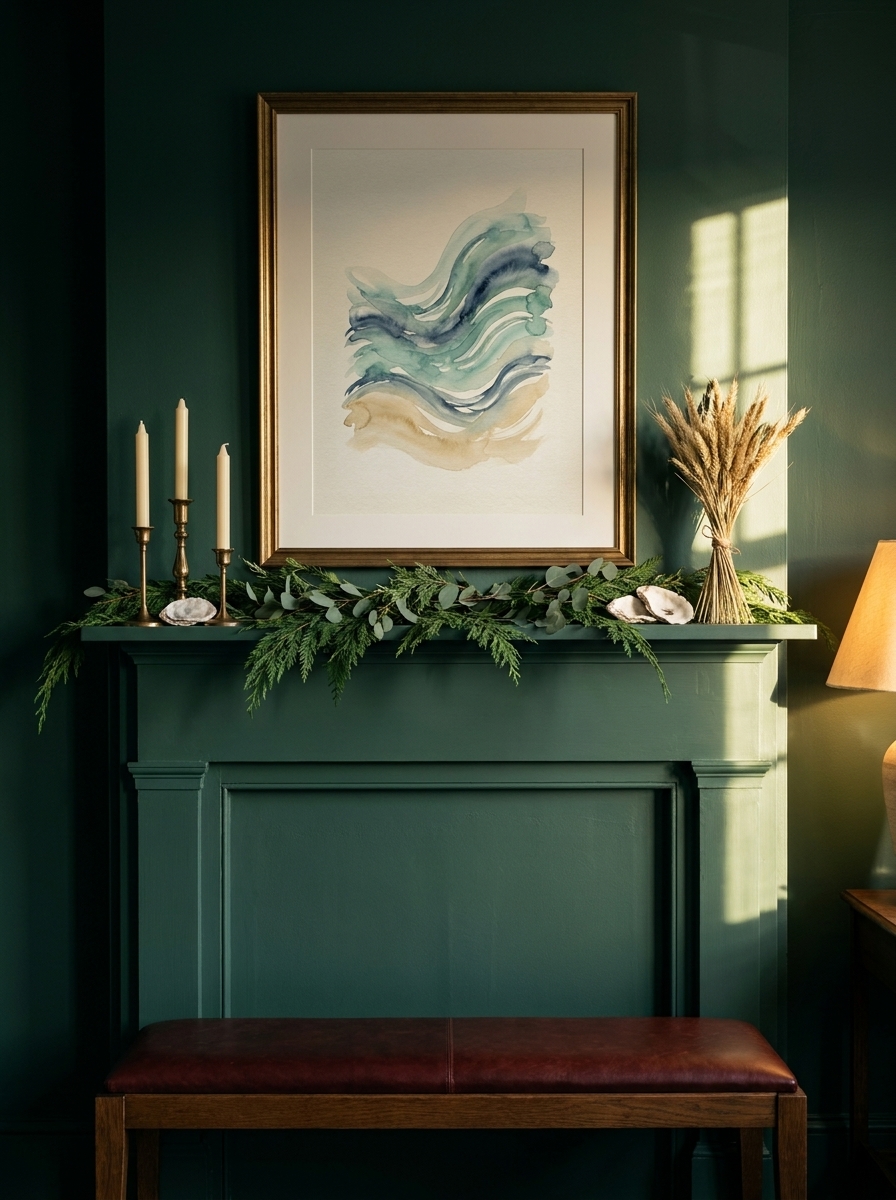
1. Greenery first, ornaments last. Lay the garland before you add a single object. Mantels fail when the greenery gets squeezed in afterward as filler.
2. Let one metal lead. Brass or silver both work, but pick one to repeat. A dominant finish used three or four times reads intentional; equal amounts of competing metals make a small mantel feel busy.
3. Swap the red for sea glass. Everything red in a standard holiday kit has a pale blue-green equivalent — ribbon, baubles, candles, berries. Take the red out and the mantel stops fighting your walls.
4. The art stays up. Do not take the framed prints down to make room for a wreath. Run the garland along the shelf beneath them so it frames the art instead of covering it.
5. Odd numbers, three heights. Three candlesticks, not four: something tall, something mid, something low. It is why a styled mantel looks relaxed instead of lined up.
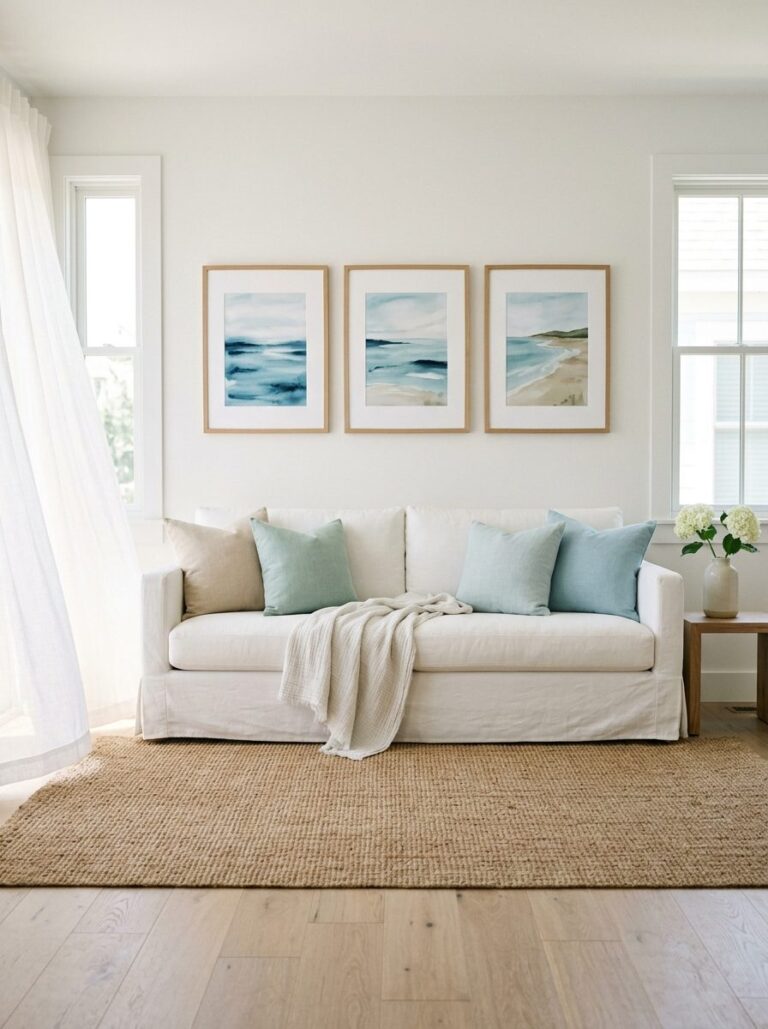
If your art feels too summery once the candles are lit, the Abstract Ocean Art set reads surprisingly rich in warm winter light — and being printable, the swap costs a print run, not another frame.
Where garland goes, and where it does not
Garland is the most over-applied thing in December. It is never the garland itself, it is that it ends up in six places at once and the house starts looking upholstered.
The banister, loose and low. Swag it along the outside of the rail instead of wrapping it. A loose drape catches light; a tight wrap looks like insulation.
One doorway, not every doorway. Pick the one people actually walk through. Greenery over every opening is how a hallway starts to feel narrow.
Never across framed art. A swag over the top of a frame cuts the art in half and reads as clutter. Garland goes below or beside, never over.
Anchor both ends, skip the bows. Secure each end, then stop. A big fabric bow at every anchor point is the fastest way to make a coastal room look traditional.
Choose cedar over stiff pine. Cedar, juniper, olive, or a little eucalyptus falls loosely and dries to a soft grey-green that suits a pale room. If you use faux, look for irregular branches rather than dense, perfectly shaped pine.
Fewer lights than you think. Warm white micro-lights tucked inside the greenery give you the glow without turning the garland into the main event.
The holiday table: six swaps
All six can be done in the hour before people arrive.
1. A linen runner, not a tablecloth. A runner leaves the wood showing, so it still feels like your table. A full cloth turns it into a banquet.
2. Oyster shells as place cards. Write the name onto a clean, thoroughly dried shell in a paint pen. Costs nothing, and guests take them home.
3. Cedar sprigs, no poinsettias. Short cuttings laid flat down the center do more than an arrangement, and nobody has to see around them.
4. Keep most of the candlelight low. Tapers are beautiful, but keep them sparse and out of the sightlines. Low pillars and tea lights give the glow without making people talk around a candle.
5. One blue, repeated three times. Napkins, a serving bowl, the rim of a glass. One blue three times reads as a scheme; five blues read as whatever was in the cupboard.
6. Clear the middle. Whatever you built down the center, take a third away before people sit down. Food has to land somewhere, and an over-styled table is one nobody can eat at.
I have stopped trying to make the table look finished before the food arrives. If there is nowhere to put the serving dishes, I decorated too much.
The guest bathroom: five things holiday guests notice
If anyone is staying over, the guest bathroom gets more attention per square foot than any room in the house, and it is always the last one anyone thinks about.
1. Two towels, folded not rolled. Two, so nobody has to ask. Folded, because rolled towels on a shelf look like a spa and unravel like a hotel.
2. Decant the soap. A simple glass or ceramic pump makes an ordinary sink feel considered. Guests notice it without knowing why.
3. Somewhere to set a toiletry bag. The one everybody misses. A stool, a shelf, or eight clear inches of counter, or the bag ends up balanced on the sink.
4. One small framed print. A small bathroom rarely needs a gallery wall. One quiet piece finishes the room without crowding it — a coastal line drawing does it without adding noise.
5. The spare roll in plain sight. Not in the cupboard. Standing on the shelf. Nobody wants to go looking, and no guest ever thought less of a house for it.
One seasonal touch is enough in a room this small: a cedar clipping in a bottle, or one candle on the shelf.
Where to start
Coastal Christmas in five moves: keep your existing art, add loose greenery, use warm white lights, let one metal lead, repeat one muted blue.
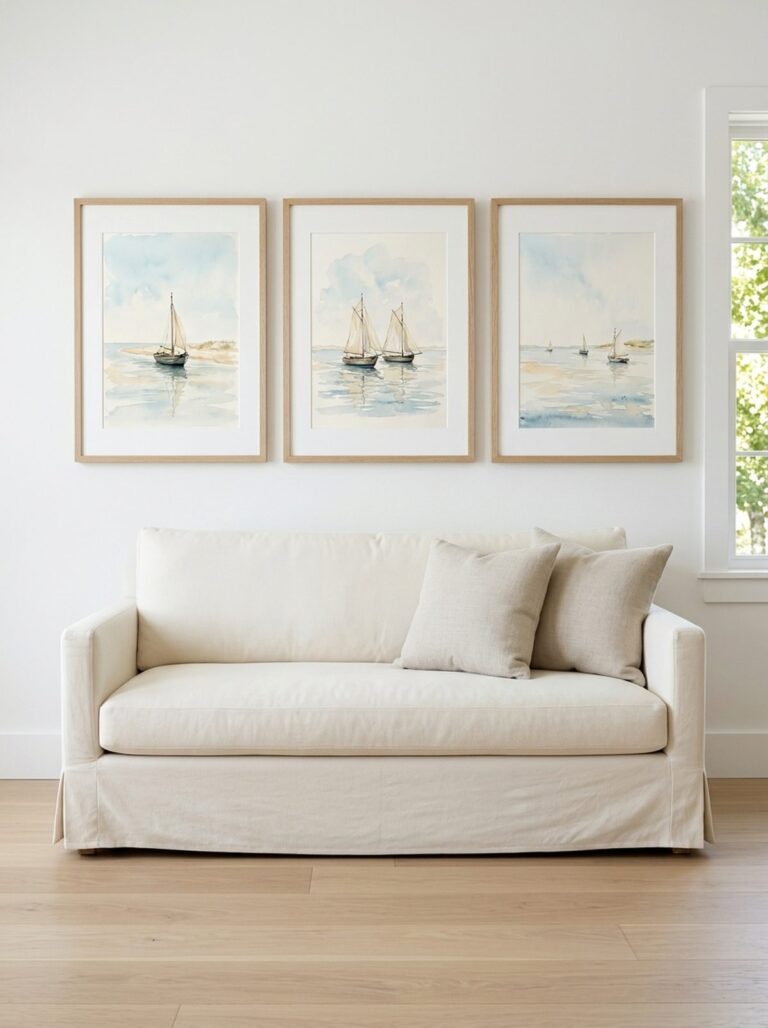
Do the mantel first: twenty minutes, and it shifts the whole room. The table and the bathroom are same-day jobs. If the walls are what feels off, start there instead — the coastal wall art sets are instant downloads, so a seasonal swap is a print run and an afternoon, not something you box up again in January.
The goal is not to make a coastal house look Christmassy in the traditional sense. It is to let December into the house without asking the house to become something else. Greenery, warm light, a little metal, and a few thoughtful swaps are usually enough.